
The identification of Tuber species has traditionally been based on the morphological characteristics of ascocarps and microscopic features of peridium and ascospores (Montecchi & Sarasini 2000). Over time, descriptions of the mycorrhizae formed by various Tuber species in association with different host plants have also been published (Palenzona 1969; Palenzona et al. 1972; Giraud 1979, 1988; Agerer 1986; Bencivenga & Granetti 1990; Fontana et al. 1990, 1992; Zambonelli et al. 1993; Rubini et al. 2001, Mello et al. 2001; Baciarelli Falini et al. 2006; Boutahir et al. 2013; Wang et al. 2013; Marozzi et al. 2018; Huang et al. 2020).
However, morphological approaches alone often fail to reliably distinguish certain Tuber species due to morphological variability and overlapping traits. This limitation is particularly evident in ectomycorrhizae, which exhibit fewer diagnostic features compared to fruit-bodies (ascocarps).
Since the late 1990s, research on Tuber taxonomy and mycorrhiza identification has increasingly relied on the use of molecular markers (see Amicucci & Ranocchi 2024 for a recent review). The most widely used method involves polymerase chain reaction (PCR) amplification of standard fungal barcode regions, such as the Internal Transcribed Spacer (ITS) region of ribosomal DNA, the β-tubulin gene (Amicucci & Ranocchi 2024). Sequences of these regions, especially ITS, have accumulated in GenBank database (https://www.ncbi.nlm.nih.gov/genbank/) for numerous Tuber species, enabling the development of rapid PCR assays using species-specific primers designed to target intraspecific polymorphisms.
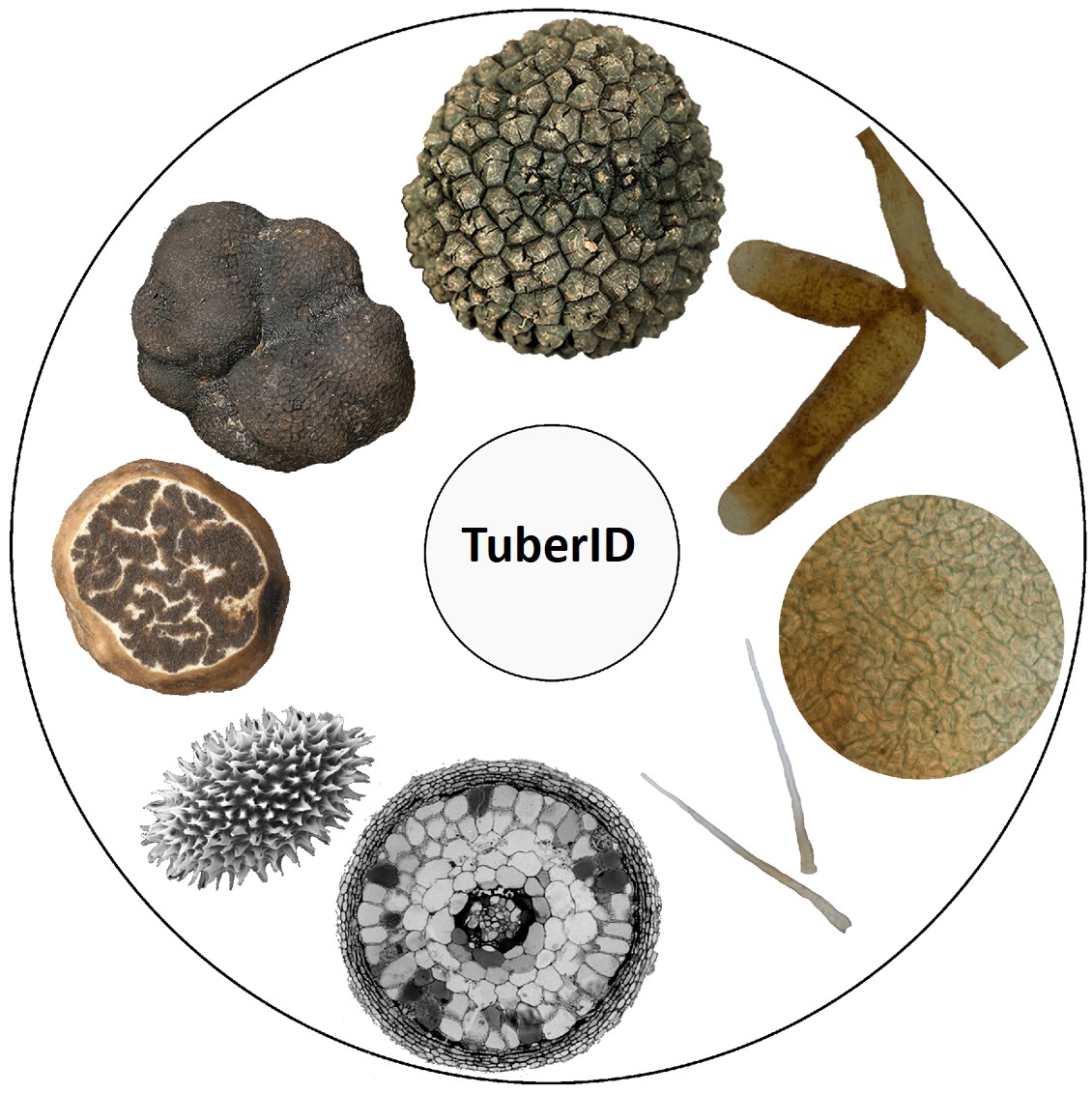

The growing body of published morphological descriptions and molecular identification protocols provides a valuable resource for accurate identification of Tuber species at both ascocarp and mycorrhizal levels. Nevertheless, to ensure the selection and application of the most suitable method, a comprehensive review and comparison of these approaches is essential.
To address these needs, we developed a database that compiles available information on the morphology of ascocarps and mycorrhizas, as well as on molecular identification methods, for both the most commercially important Tuber species and those of lesser or no economic value that may be difficult to distinguish from them.
The TuberID was developed within the INTACT Project to help researchers, growers, and enthusiasts access reliable identification resources.


© 2025 CNR-IBBR. All rights reserved.
All the material on these pages is released under the license Creative Commons Attribution-NonCommercial-NoDerivatives 4.0 International (CC BY-NC-ND 4.0)
 This project has received funding from European Union's Horizon 2020 research and innovation program under Grant Agreement #101007623.
Contacts:
Andrea Rubini, CNR-IBBR, Perugia (andrea.rubini@cnr.it)
Claudia Riccioni, CNR-IBBR, Perugia (claudia.riccioni@cnr.it)
Beatrice Belfiori, CNR-IBBR, Perugia (beatrice.belfiori@cnr.it)
Web Manager:
Gabriele Bucci, CNR-IBBR, Sesto Fiorentino, FI (gabriele.bucci@cnr.it)