

| Term | Description |
|---|---|
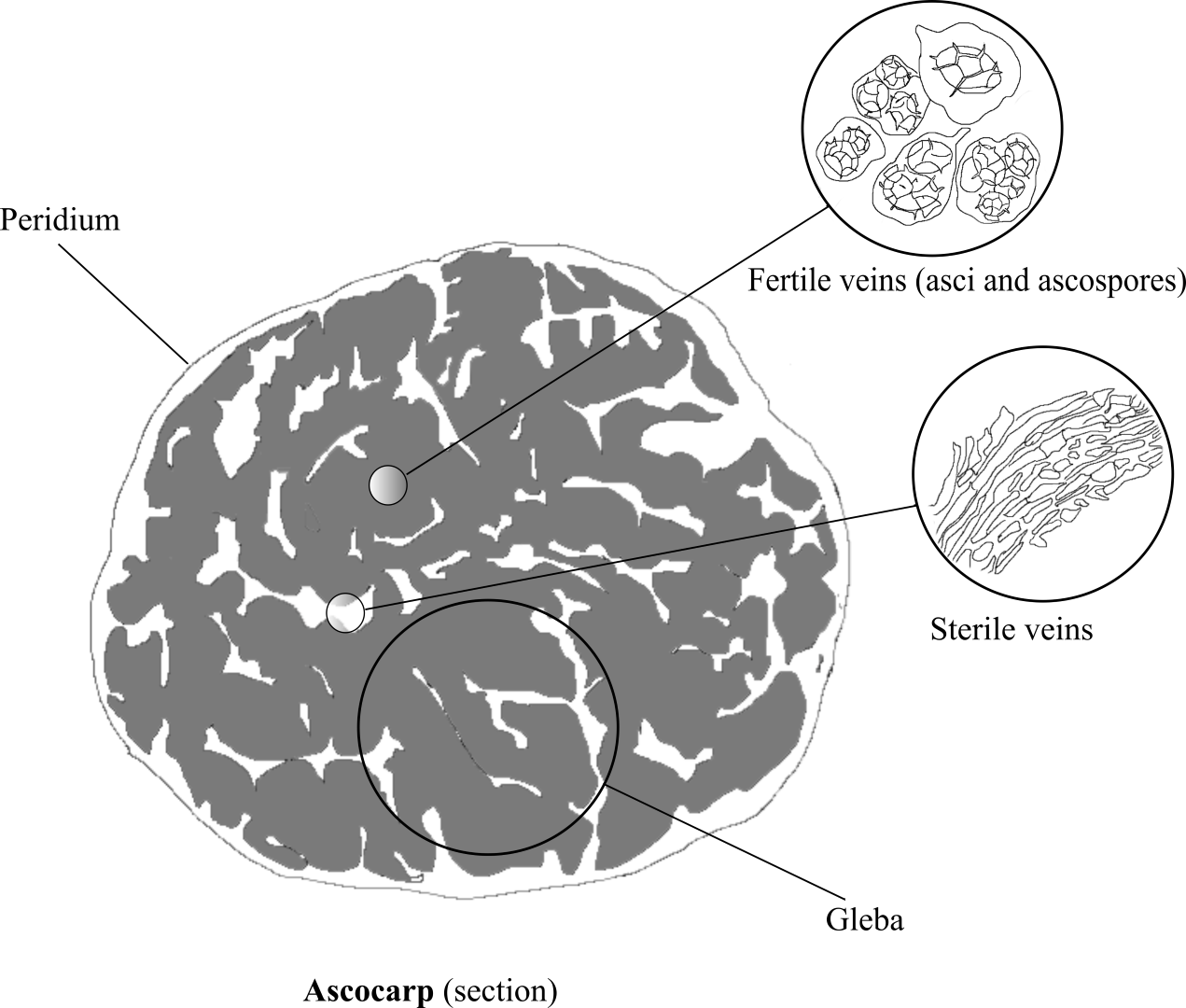
| Ascocarp | The fruiting body of an ascomycete fungus, which contains the sexual reproductive structures. |
| Ascospores | The sexual spores produced by fungi belonging to the phylum Ascomycota. |
| Ascus | Sac-like structure of ascomycete fungi, in which sexually produced spores, called ascospores, are formed. |
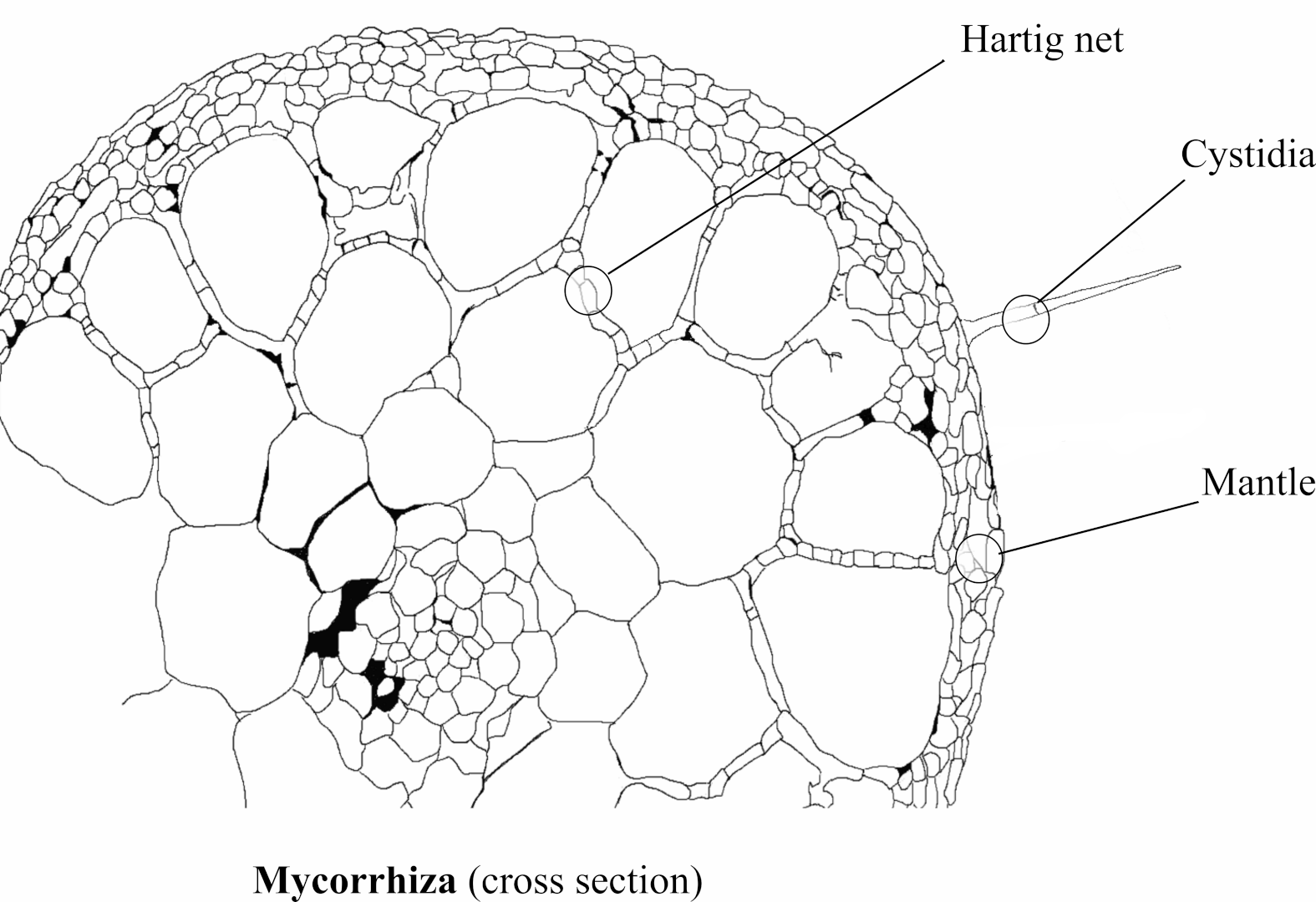
| Cystidia | Specialized, often thick-walled, hyphal structures that occur on the surface of the fungal mantle. They are typically differentiated from ordinary hyphae by their shape and function. |
| ECM | Abbreviation for ectomycorrhiza. |
| Ectomycorrhiza | A type of mycorrhiza in which the fungus forms a sheath around the root and its hyphae penetrate between root cells, creating a Hartig net. |
| Epidermoid cells | Cells located in the outer layer of the mycorrhizal mantle, resembling plant epidermal cells. |
| Fertile veins | Darker regions of the gleba that contain the hymenium, where asci and spores are produced. |
| Gleba | The internal tissue of the ascocarp, where asci and spores develop. It often exhibits a marbled pattern due to sterile veins. |
| Hartig net | A network of fungal hyphae that penetrates between the epidermal and cortical cells of the host plant root in ectomycorrhizal associations, facilitating nutrient exchange between the fungus and the plant. |
| Hymenium | Part of the ascocarp that contains reproductive structures (Asci and Spores). |
| Mantle | Synonym of mycoclena. |
| Mycoclena | A dense layer of fungal hyphae surrounding the root tips of the host plant. |
| Mycorrhiza | A symbiotic structure formed between the roots of a host plant and mycorrhizal fungi, facilitating nutrient exchange. |
| Peridium | The outer layer of the ascocarp, often textured or ornamented. |
| Sterile veins | Whitish veins within the gleba that create the characteristic marbled appearance of the ascocarp. These veins usually are connected to the external of the ascocarp. |
| Truffle | The ascocarp formed by Tuber species. |
| Warts | Melanized, pyramidal structures on the outer surface of the peridium, characteristic of black truffles. |


© 2025 CNR-IBBR. All rights reserved.
All the material on these pages is released under the license Creative Commons Attribution-NonCommercial-NoDerivatives 4.0 International (CC BY-NC-ND 4.0)
 This project has received funding from European Union's Horizon 2020 research and innovation program under Grant Agreement #101007623.
Contacts:
Andrea Rubini, CNR-IBBR, Perugia (andrea.rubini@cnr.it)
Claudia Riccioni, CNR-IBBR, Perugia (claudia.riccioni@cnr.it)
Beatrice Belfiori, CNR-IBBR, Perugia (beatrice.belfiori@cnr.it)
Web Manager:
Gabriele Bucci, CNR-IBBR, Sesto Fiorentino, FI (gabriele.bucci@cnr.it)